
Have you wished to discover the untold secrets of the world’s most famous Inca city or walk in the streets of Tokyo without even moving from your sofa? Let me introduce you to the world of Virtual Reality (VR) Walk-Throughs; it’s like holding an invisible travel déjà vu card. When time and money do not allow for direct access to a location, VR Walk-Throughs become a useful solution in many different fields. Think of a moment on the top of the Eiffel Tower with the Parisian air blowing on your face or swimming in the colorful waters of the Great Barrier Reef all from the arms reach of your couch. Not only does this emerging technology quell the itch to explore but it also invites opportunities for further learning about other cultures, travel, and more.
As we start this voyage, we will explore when and how VR technology adopted travel and tourism, find out the potential advantages for the traveller and learn how to make your own VR Walk-Through. Learn how these magical experiences work or dig into the most-loved locations you can visit in virtual reality, brace yourself for a world where concepts of fantasy mix with reality.
Virtual reality (VR) initially entered the sphere of travel and tourism at the end of the 1990 s and the beginning of the 2000s. Initially, these applications were simple, providing only a 360- degree panoramic view of the place. This technology was first used by hotels and resorts to offer the interested customers virtual tours of the offered premises. These early VR were less interactive and many of them were experienced via a desktop interface, a mere preview of the future experiences.
These kinds of VR walk-throughs have come a long way and are closer to real life than ever nowadays. High-resolution interactive 3D environments along with superior VR headsets provide the user with tourism experiences to depths unimaginable. Instead of going out, users can now walk through the trading areas of the city, the ruins, or even the beaches. Larger travel agencies and most of the tourism boards globally have adopted this technology primarily as a marketing strategy for selling destinations and products.
There is a bright future for VR in the sphere of travel. Shortly, as technology develops and improves, we will see even better and more interactive VR. Haptic feedback systems may one day suffice or provide the user with the texture and the temperature, making it feel as if you are there. It was also noteworthy that AI-assisted virtual tour guides might be more interactive and could potentially personalize their experiences based on the user’s interests or preferences. Furthermore, the combination of AR with VR might output mixed-reality environments or infuse VR with aspects of already existing travel reality, changing the existing traveling experience completely.



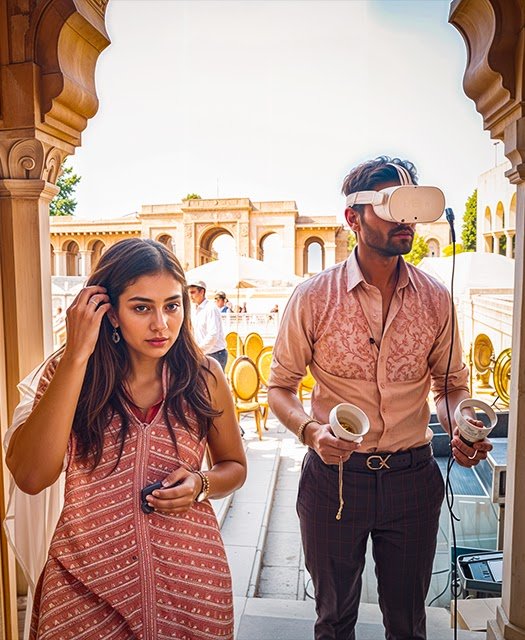
Virtual tours, as we know, have brought a new way of touring the best destinations around the globe altogether with just a click. We have discussed the technological aspect of VR and its development in the travel and tourism context clearly outlining great ways in which this form of immersive experience helps travelers. It is fascinating to realize that VR has made many places that tourists may want to visit available to preview and plan. Not only do I think that this technology will continue to develop further, and not only do I think that there will be more chances for those of us who are interested in creating walk-throughs and applying it to travel, but I think that in the future there will be a lot more chances for people themselves to create them and combine it with real-life travel. Of course, one must confess that there are some benefits of using VR as a tool for boosting the experience of traveling. Incorporating this technology means the promise of what a lot of us only dream of every day can become a reality—to improve the world and to go out on new adventures.

VR walkthrough is the process of actually ‘walking through’ a space virtually using VR technology. Actually, it may represent real physical spaces or 3D television or movie theaters; it applies to the sphere of real estate businesses, architectural bureaus, schools, and theaters.
VR headset provide the most engaging experience but you can watch the walkthrough on a desktop, tablet or mobile in compatible browsers or apps
Yes, you can shoot if the walkthrough has them, open doors, lift objects, activate some animals, or turn on animations. Some of these features will therefore depend on the design of the VR walkthrough.
● The ability of presenting space realistically. ● Activities that help readers become more involved. ● Possibilities to reach places which are difficult to access or even impossible to reach otherwise. ● Saves time for the client, customer or the stake holder.
This test security now depends on the space that the VR walkthrough will be hosted on. The legit service providers employ the mechanisms such as encryption with the secure servers so that none of the users’ data remains unprotected.